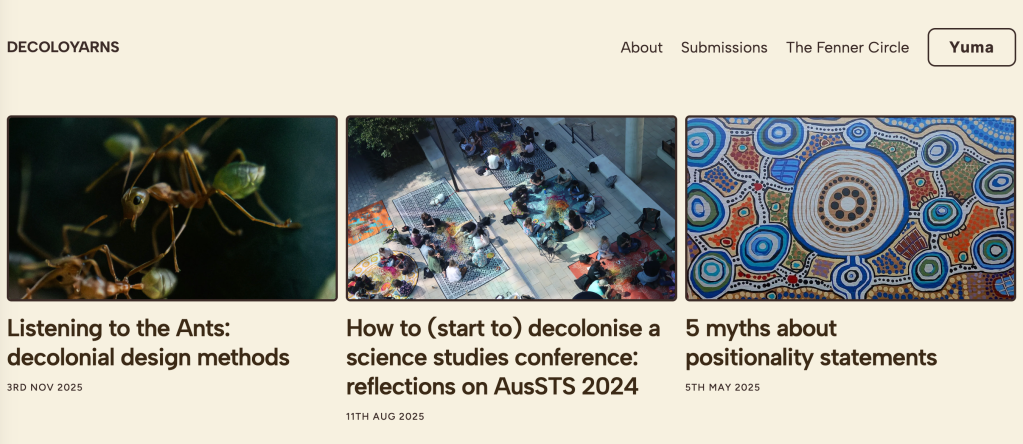
Since January 2025 I have served as Editorial Convenor of Decoloyarns, a website dedicated to publishing short, Indigenous-mentored pieces of writing that concerning decolonising environmental sciences, and broader writing and research practices in the academy. Decoloyarns is part of the Fenner Decolonising Research and Teaching Circle at the Australian National University Fenner School of Environment and Society.
Decoloyarns is cared for through a circle-based model of governance and decision-making that is Indigenous-led, meaning First Peoples lead the editorial practices, decision making, and ultimately discern what will be published on the site in terms of how it realises decolonising practices in research. Settlers bring skills, problem-solving, and hands-on support to realising the direction we are offered. As Editorial Convenor, my role is to keep Decoloyarns well: ensure completions are buoyed, walk with authors and mentors through development of pieces to ensure everyone is resourced, maintain the website, support circulation and calls for work, source and suggest images that are decided on by authors and First Nations writing mentors, and upload pieces.
What words do writings on AI use, when talking about AI writing, and aiding writing? What is it that AI actually does? And what support to scholars actually need to write?
Working with colleagues at Monash University Faculty of Education, we are analysing literatures from higher education writing practice and computer science respectively, as data sets to understand how different disciplines understand what writing is in a world where AI, we are told and tell each other, can help us do it.
In an Australian context, while innovative and exemplar research is especially praised and prized, how do universities go about practically supporting PhD students who take up unusual, non-traditional and extraordinary projects? With a three year deadline, what kinds of supports have worked to ensure that scholars are able to develop and forge their fields in exceptional circumstances?
Alongside colleagues at the Australian National University College of Asia and the Pacific, using an analytical framework that braids lived experiences of PhD completion, we are proposing and describing a flexible, proven, and consistent pedagogy of support and community for PhD students who take more than five years to complete unpredictable projects, with extremely worthy ends.

This project compares two collections of data from 2018 and 2025 respectively, and a themes and keywords-based semantic analysis of stock images, to consider how visual representations of menstruants are used in relation to mainstream news coverage of movements for menstrual leave. What might these representations say about how news coverage expects audiences to respond to idea of what being worthy for rest looks like for menstruants?
Findings were presented at the Nordic Network for Gender, Body, Health conference at Stockholm University: Curating Health: Graphic Medicine and Visual Representations of Illness.
 Ro Stevens